Light Therapy, Explained: What Your Cells Actually Do With Red and Near-Infrared Light
You’re staring at forty-seven red light panels on Amazon.
One claims to “reverse aging at the cellular level.” Another promises “NASA-developed technology.” A third has 4,200 five-star reviews and a name you can’t pronounce. The price range runs from $39 to $3,900, and every single listing sounds like it was written by the same breathless marketing team.
Meanwhile, TikTok has decided that red light therapy is the new wellness miracle. Celebrities are posting selfies in glowing LED masks. Your neighbor bought a panel for her dog. And somewhere in the back of your mind, a reasonable voice is asking: Is any of this actually real?
I know that voice. I’ve been that person.
Not because I saw a trending hashtag. Because my brain demanded it.
How I Ended Up Here
I’ve sustained six concussions over my lifetime. The worst came in 1999, when I fell off a roof while building a home — the ER doctors told me they couldn’t believe I was walking away. I missed three days of work and went right back to managing multi-million-dollar electrical projects. Because in the trades, that’s what you do. You push through.
It took a severe car accident concussion in 2016 — and seeing my own brain activity on a quantitative EEG for the first time — to understand that “pushing through” had a cost my brain was still paying. Then in 2018, a hockey concussion left me with a constant headache that lasted five months. Five months of managing complex projects, leading people, and fighting through cognitive fog every single day.
When you’ve lived that, you stop scrolling past the marketing claims. You start reading the research. And when you find something with real physiological mechanisms behind it — not just hype — you pay attention.
Photobiomodulation got my attention. Not because of TikTok. Because of what it does inside the cell.
What’s Actually Happening When Light Hits Your Body
Here’s the thing most red light therapy marketing won’t tell you: your cells already know what to do with light. They’ve been doing it for billions of years. The question isn’t whether light affects biology — it’s which light, how much, and through what mechanism.
The term you’ll encounter is photobiomodulation, often shortened to PBM. It’s the current scientific name for what used to be called low-level laser therapy (LLLT) or simply “red light therapy.” The name change matters because it’s more precise: photo (light) + bio (living systems) + modulation (adjustment, not destruction). We’re not cutting, burning, or ablating tissue. We’re nudging cellular behavior with specific wavelengths of light.
And that specificity is everything.
Not all light does this. Blue light doesn’t. Green light doesn’t. Ultraviolet certainly doesn’t — not in the same way. What works falls within what scientists call the optical window: wavelengths roughly between 600 and 1,000 nanometers. That’s the red and near-infrared portion of the spectrum. It’s the range where light can actually penetrate skin and tissue to reach the cells underneath, rather than being absorbed by water or hemoglobin at the surface.
Red light in the 630–660nm range penetrates a few millimeters. Near-infrared light around 810–850nm can reach five to ten millimeters and beyond — deep enough to affect muscle, joint tissue, and even the brain through the skull.
But penetration alone doesn’t explain the effect. What matters is what the light meets when it gets there.
The Lock Your Cells Already Have
Deep inside nearly every cell in your body sit mitochondria — the structures responsible for producing the energy your cells run on. If you remember anything from biology class, it’s probably “the mitochondria is the powerhouse of the cell.” Turns out that bumper-sticker fact is genuinely important here.
Within the mitochondria, Cytochrome C Oxidase (Complex IV) acts as the “engine’s intake valve.” This enzyme is the final gatekeeper before your cells churn out ATP — the energy currency that drives virtually every cellular process: repair, signaling, inflammation management, growth.
Here’s the magic: CCO contains light-sensitive copper and iron centers. When these centers absorb red (660nm) and near-infrared (850nm) photons, they shed inhibitory molecules like Nitric Oxide. This “unlocks” the enzyme, allowing oxygen to flood back in and supercharge energy production. It isn’t just marketing; it’s a direct physical resonance between light and life.
That single unlocking event sets off a cascade of real, measurable downstream effects:
More ATP production. With CCO unblocked, the electron transport chain runs more efficiently. Cells have more energy to do their jobs — whether that’s repairing damaged tissue, reducing inflammation, or maintaining normal function.
Freed Nitric Oxide goes to work. The NO that was displaced from CCO doesn’t just disappear — it enters surrounding tissue, dilating blood vessels and improving local blood flow and signaling. This is one reason PBM can affect areas beyond just the cells directly hit by the light.
Managed inflammation. PBM modulates the activity of NF-κB, a key regulator of inflammatory response. In overly inflamed tissue, it helps calm things down. In under-responsive tissue, it can gently activate healing pathways. This bidirectional quality is unusual and important — it’s not a blunt “anti-inflammatory” like popping ibuprofen. It’s a modulator.
This isn’t theoretical. A 2025 umbrella review of randomized controlled trials across multiple health outcomes confirmed that PBM shows meaningful effects, particularly for pain, inflammation, and tissue repair. Brain-specific research — including a 2025 randomized placebo-controlled trial on mild traumatic brain injury — showed improvements in cognitive function, sleep quality, and post-concussion symptoms after transcranial PBM.
I don’t cite these studies to impress you. I cite them because when you’ve had six concussions, you need the research to be real. And in this case, the mechanisms make physiological sense. That’s not something I can say about every wellness product on the market.
Why More Isn’t Always Better
Here’s where most red light marketing falls apart, and where my practitioner brain kicks in.
PBM follows what’s called a biphasic dose response — sometimes referred to as the Arndt-Schulz curve. In plain language: a moderate dose of the right light produces beneficial effects. Too little does nothing noticeable. Too much can actually inhibit the very processes you’re trying to support.
This is not intuitive. We’re wired to think that if something works, more of it works better. But cellular biology doesn’t care about our intuitions. There is a therapeutic window, and staying inside it matters.
This is also why the $39 Amazon panel and the $3,900 clinical device can both be wrong for you — the cheap one might not deliver enough energy at the right wavelengths, while the expensive one might be overkill for your situation, or designed for a clinical setting with protocols you’re not following.
The dose is a function of wavelength, power density, distance, and time. Change any one of those variables, and you change the dose. This is why “just stand in front of it for twenty minutes” isn’t a protocol — it’s a guess.
The Three Families of Devices
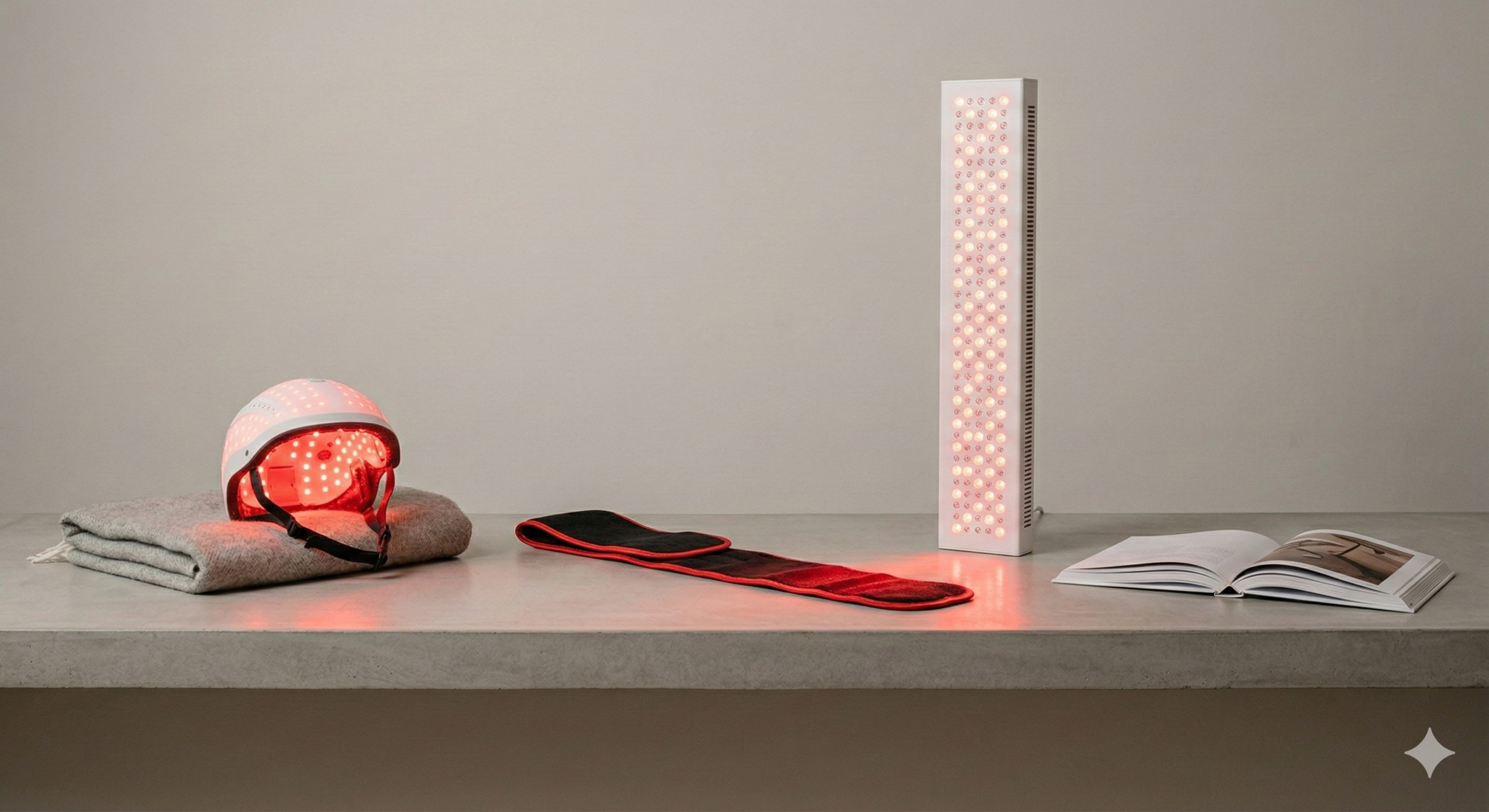
Without getting into specific brands yet (that’s coming in Part 3 of this series), PBM devices generally fall into three categories:
Full-body panels. These are the large, wall-mounted or free-standing LED arrays you see all over social media. They typically combine red (660nm) and near-infrared (850nm) wavelengths and are designed for broad coverage — skin health, muscle recovery, general wellness. They’re the most popular consumer devices, and the most variable in quality.
Transcranial and intranasal devices. These are designed specifically for the brain. They deliver near-infrared light (typically 810nm) through the skull or nasal passages to reach brain tissue. This is the category most relevant to concussion recovery, cognitive enhancement, and neurodegenerative research. It’s also the category with some of the most compelling clinical research.
Handheld and targeted devices. Smaller, portable units designed for specific areas — a sore joint, a wound, a localized injury. They’re often used in clinical settings by physical therapists and chiropractors, and increasingly by consumers for targeted pain management.
Each category has different strengths, different research backing, and different price points. Understanding which one matches your goals is the difference between a smart investment and an expensive nightlight.
What the Research Actually Supports — And Where It’s Still Emerging
I don’t study these tools in isolation. I evaluate them as part of integrated human systems — brain, body, lifestyle, stress, sleep, and environment all matter. That perspective matters when you’re assessing what PBM can and can’t do.
Where the evidence is strongest: Pain management — particularly for conditions like fibromyalgia and neuropathic pain. Wound healing and tissue repair. Post-exercise recovery. These areas have multiple randomized controlled trials and systematic reviews supporting meaningful effects.
Where the evidence is promising but still building: Traumatic brain injury and concussion recovery. Cognitive enhancement in healthy adults. Neurodegenerative conditions like Alzheimer’s and Parkinson’s disease. Sleep quality. The mechanism makes sense, early clinical results are encouraging, but we need larger trials with standardized protocols before anyone should call these “proven.”
Where you should be skeptical: Any claim that red light therapy “cures” anything. Any device marketed with before-and-after photos that look too good to be true. Any company that references “NASA studies” without actually citing them. Any product that claims identical benefits regardless of wavelength, dose, or application.
The gap between what the science supports and what the marketing promises is where confusion lives. My job — on this site and in my practice — is to close that gap with honest translation.
Where We Go From Here
This is Part 1 of a four-part series. Now that you understand the foundation — what PBM is, why it works at the cellular level, and why the market is so confusing — we’ll go deeper:
Part 2 (PBM 201) dives into the research: which studies matter, what they actually found, and how to read PBM evidence like a practitioner, not a consumer.
Part 3 (PBM 301) is the device guide: what to look for, what to avoid, and how to match a device category to your actual goals.
Part 4 (PBM 401) is the protocol article: how to build a PBM practice that works within your life, including how I integrate light therapy with PEMF, neurofeedback, and other modalities in my own recovery.
Technology should support the body’s innate capacity to regulate and heal — not replace it. Red and near-infrared light aren’t magic. They’re physics, meeting biology, at the right wavelength. Your cells already have the lock. The question is whether you’re using the right key, in the right dose, for the right reason.
That’s what this series is here to help you figure out.

Written by
David Johansson
Certified brain health coach with BCIA didactic coursework in neurofeedback and five years as a neurofeedback technician. He has sustained several concussions and spent years on the recovery work that followed, measuring what actually helped against his own quantitative EEG data.
He is a co-owner and operations manager at Total Neuro Solutions in Colorado, the neurofeedback practice led by his wife, Shari Johansson, MA, LPC, BCN, QEEG-D, a board-certified neurofeedback specialist and QEEG diplomate.
More about David →Affiliate Disclosure: Some links on this site are affiliate links, which means I may earn a small commission if you make a purchase through them. This comes at no additional cost to you. I only recommend products I have personally evaluated, used, or believe in based on my professional experience. My opinions are my own, and affiliate relationships never influence my assessments or recommendations.