Neurofeedback and qEEG, Explained: What a Brain Map Actually Shows You
If you’ve heard the word “neurofeedback” and quietly filed it next to the phone apps that promise a sharper brain in ten minutes a day, I don’t blame you. Most of those apps train you to get better at the app. You improve at spotting shapes on a screen, and your brain politely declines to carry any of it into your actual life.
So the skepticism is earned. It’s just aimed at the wrong target.
Neurofeedback isn’t a game you get good at. It’s a way of showing your brain its own electrical activity in real time so it can learn to regulate itself. And the gap between those two things isn’t marketing, it’s mechanism. One asks you to practice a task. The other changes the thing doing the practicing.
So before you write it off, or hand someone your money, here’s what neurofeedback actually is, what a brain map can and can’t show you, and how to tell the real thing from the noise.
First, untangle two things people treat as one
Most confusion about neurofeedback comes from bundling two separate things into one word.
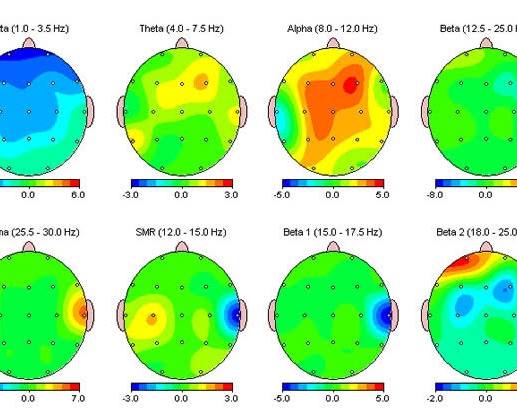
The first is the assessment: a qEEG, or quantitative EEG. Think of it as a map. It shows where your brain’s electrical activity is running fast, slow, or out of sync. It’s a picture of how your brain is operating right now. It doesn’t change anything. It tells you where you are.
The second is the training: neurofeedback itself. That’s the part that works with your brain over time, using the map to aim at something specific rather than guessing.
EEG assessment first, then the training. You read the terrain before you decide where to walk.
The difference between a real EEG quantitative analysis and expensive pictures is the person who reads the raw signal behind it. Much of what gets handed to patients is generated automatically, and machine learning automation is very good at producing a images and very bad at knowing whether it just mistook your eye blink for a brain problem. We’ll get into exactly how that happens next.
What a qEEG actually measures
A qualified qEEG professional can tell most of what you need to know from the raw wave form and uses the “maps” to show the client.
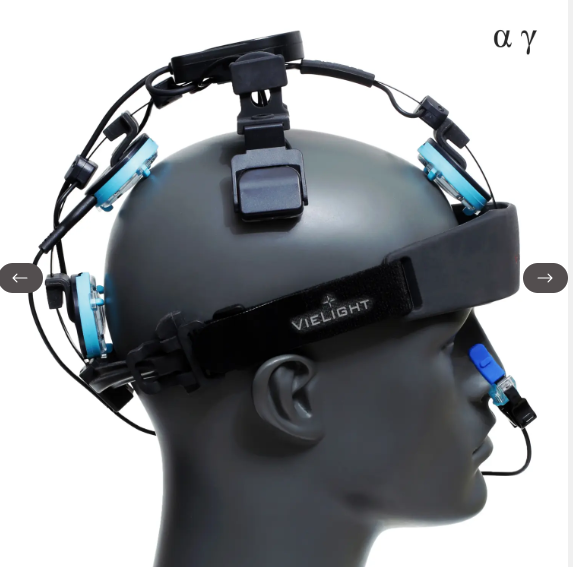
Your brain runs on electricity. Billions of neurons fire in rhythm, and when enough of them fire together, that activity is strong enough to read through your scalp. Place sensors on the head and you get a live stream of squiggling lines, the actual electrical traces. That stream is the real data. Everything else is a summary of it.
The “quantitative” part is what an EEG professional and computer does next. A process called a Fast Fourier Transform breaks that messy signal into its component frequencies (slow delta and theta, mid-range alpha, faster beta) and measures how much of each is present, where, and whether regions are communicating efficiently. It compares your patterns against a database of other brains, and a skilled reader also compares your brain against itself across the recording. The output is the head map: reds and blues showing where you’re running fast, slow, or out of sync.
One thing to hold onto: the map is a calculation built on top of the raw signal. If the signal going in is faulty, the map coming out is faulty.
Why the eye-blink problem matters
Your eyes are, electrically, a pair of tiny batteries: the front of the eye carries a positive charge relative to the back. Every time you blink, that battery swings and throws a large electrical spike across the front of your head. We’re talking 100 to 500 microvolts, which dwarfs the actual brainwaves underneath.
On the raw trace, a blink shows up as a big, slow, wave over the frontal sensors. And slow frontal waves happen to resemble delta, the kind of slowing a clinician associates with dysfunction.
Now imagine no one cleans those blinks out. The software doesn’t know it’s looking at eye dipoles. It counts every blink as brain activity, tallies a pile of slow power across the front of the head, and generates a map reporting frontal slowing. On an automatically produced map, that can look like a problem that isn’t there, and in inexperienced hands, get read as a sign of cognitive decline.
An experienced reader isn’t fooled, because the raw EEG gives it away. Real slowing is constant and widespread; it’s there whether your eyes are open or closed. A blink is brief, confined to the front, and it lines up exactly with the eye movement. Trust only the picture, and you may spend money doing nothing for the brain.
It happens more easily than you’d think. Recently, while learning a new software, we ran one of my own EEGs through the machine automated analysis before the artifact removal was done. The map lit up with dominant gamma across the back of my head: fast, high-frequency activity, right where you wouldn’t expect it. It wasn’t my brain. It was muscle tension from a dislocated shoulder and the spasms I’d been fighting in my neck and shoulders. The software didn’t know the difference. It did the math on whatever signal it was handed.
That’s why Shari never generates a colored head map until she’s gone through the raw recording first and removes all of the artifacts: eye blinks, movement, 60-cycle electrical noise, all of it. The artifact recognition and removal isn’t a formality. It’s the difference between a map of your brain and a map of your eye movement, your jaw, and the tension in your neck-electrical dipoles from your body, not your brain.
So, a fair question to ask anyone who hands you a brain map: was the raw data cleaned by a person before this was generated, or did the software do it on its own? If they can’t answer that clearly beware.
A quick word on brainwaves before we go further
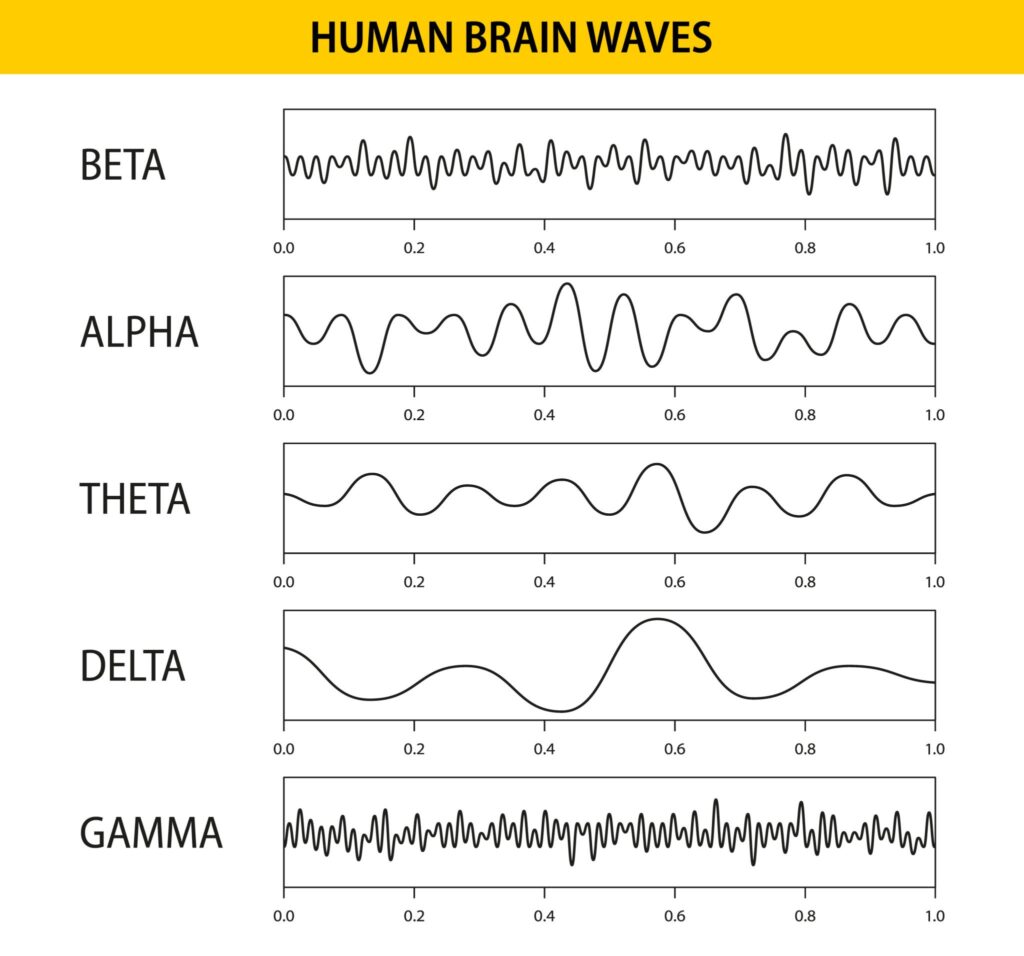
You’ve seen a few of these terms already, so let’s make all five mean something. Treat them as a vocabulary, not a scorecard. No single band is “good” or “bad.” The real information is always in the balance between them, where they show up, and what your brain is doing at the time.
Here is a simplified explanation, from slowest to fastest:
Delta (roughly 0.5 to 4 Hz) is the slowest band, and it rules deep, dreamless sleep, which is exactly where it belongs. The trouble starts when too much delta shows up while you’re awake, in a region that’s supposed to be alert and engaged. That’s what clinicians mean by “slowing”: part of the brain is asleep when it should be working. You never feel the number on the chart. You feel its downstream effects: the brain fog, the half-second lag between a question and your answer, the sense that thinking takes more effort than it used to, the word that’s right there but won’t come when you reach for it.
Theta (about 4 to 8 Hz) is the drifting state between waking and sleep, and too much of it in the front of the brain is one of the patterns tied to inattention.
Alpha (around 8 to 12 Hz) is calm, relaxed, still awake but the brain idling.
Beta (roughly 12 to 22 Hz) is active, engaged thinking; useful in the right amount, but too much (22-30 Hz) in the wrong place can feel like anxiety, or a mind that won’t quiet down.
Then there’s gamma (30 Hz and up), the fastest, and the one most people misunderstand. Gamma isn’t about thinking faster. It’s about thinking together. It’s the band that synchronizes far-flung parts of the brain so that perception, attention, and memory operate as a coordinated whole, rather than separate instruments playing over each other. (It’s also, exactly where muscle tension likes to hide.)
What neurofeedback actually is
Back to the skeptic’s question from the top: if it isn’t a brain-training game, what is it?
Neurofeedback is your brain watching its own activity in real time and learning from what it sees. The same sensors that read your brainwaves for a qEEG can feed that signal back to you live, usually through something simple, like a movie that plays clearly when your brain produces the pattern you’re aiming for, and dims or stalls when it drifts away.
That’s the mechanism of learning, and it’s older than it sounds: operant conditioning. Reward a behavior and it repeats. Your brain is a reward-seeking organ, so when a certain pattern keeps the movie running, it quietly learns to make more of that frequency, not because you’re consciously trying, but because the feedback keeps pointing the way. You aren’t being given anything. Your brain is practicing.
Training versus stimulation: different tools, different jobs
This is the distinction people most often blur, so let me be plain: neurofeedback is training, not stimulation. Nothing is being put into your brain. But that doesn’t make stimulation the lesser option. It does a different job.
Stimulation applies a little energy to the brain to wake it up and get it to pay attention, and it comes in a range of intensities. At the gentle end are photobiomodulation (PBM, or red and near-infrared light) and PEMF, pulsed electromagnetic fields. Step up and you have tDCS and tACS, which pass a weak electrical current. Stronger still is TMS, which uses magnetic pulses forceful enough to fire neurons directly. Different power, same broad idea: nudge the system toward a more workable state.
In practice, they fit together. We’d often use PBM or tDCS before a neurofeedback session, to rouse a sluggish brain so it’s ready to learn.
Neurofeedback is the part that teaches. By rewarding healthy patterns over many repetitions, it trains neurons to hold those patterns on their own, which is how a temporary state becomes a lasting trait. Stimulation can open the door. Neurofeedback is how the brain learns to walk through it without being pushed.
We’re usually asking the wrong question
Somewhere online, a headline is telling you a study found neurofeedback doesn’t work for ADHD. Before you close the tab and cross it off your list, look harder, because the trouble isn’t the answer. It’s the question.
“Does neurofeedback work for ADHD?” assumes ADHD is one thing. It isn’t. Sit with two children who earned the very same diagnosis and you’ll often find two different brains. One drifts: the teacher’s voice goes soft and turns into the grown-up from a Peanuts cartoon, wah wah wah, while the child watches dust float through a sunbeam. The other doesn’t drift so much as ricochet: the teacher says “bologna,” and now the whole mind is three towns away, deciding what’s for lunch. Same box checked on the form.
So when a large 2024 review in JAMA Psychiatry pools nearly 2,500 people under the single word “ADHD,” trains their very different brains in a scattershot of different ways, and averages the results, the honest outcome is close to nothing. Not because the brain can’t change, but because you’ve blended a dozen different situations into one number and asked it to mean something it can’t.
That’s what the wrong question produces. Ask a better one, look at the studies that used consistent, well-designed protocols instead of averaging everything together, and the picture flips. On the standard five-level scale that professional bodies (AAPB and ISNR) use to grade clinical efficacy, neurofeedback for ADHD reaches Level 5, “Efficacious and Specific,” the top rating, meaning the benefit holds up as specific to the training, not a placebo. (ISNR evidence-base review; Arns et al., 2009 meta-analysis)
Learning to ask the sharper question, of your own brain and of the studies you’ll run into, is a skill worth having. Read the companion piece: Are We Asking the Right Question? How to Read Your Own Health Without Getting Fooled.
The neurofeedback process, and how to know if it is effective
Neurofeedback is training, and training takes repetition. That one fact should reshape your expectations before you begin. This isn’t a pill you take once or a device you strap on for an afternoon. It’s closer to physical therapy for the brain: small, repeated sessions that accumulate.
How many? In our own tracking, most people trained roughly 30 to 40 sessions before the changes they came for settled in, and more tangled pictures often took longer. That squares with the broader research, which generally points to somewhere between 20 and 40. (That’s our own practice data, not a controlled study. I’ll always tell you which is which. But it’s honest about the pace.)
Change tends to build gradually rather than arrive overnight. So one of the clearest warning signs is anyone promising a fast, dramatic turnaround. A brain doesn’t learn a durable skill in three sessions any more than a body learns a sport in three practices.
So how long will you need it? The honest answer is: it depends, and a good practitioner tells you what it depends on instead of quoting a flat number. It depends on what your EEG actually shows. It depends on consistency; training a few times, disappearing for two weeks, then drifting back in doesn’t give the brain the steady repetition it needs to learn. It even depends on your sleep, because the learning takes hold far better in a brain that’s resting well at night. Which, yes, means good sleep and good training tend to travel together. Learning is consolidated during sleep cycles.
For most people, symptoms tend to ease somewhere in that 20 to 30 session window. More complex situations (addictions, concussion history, long COVID) can take considerably longer, sometimes 80 to 100. The range isn’t a dodge. It’s the honest consequence of a simple truth: every brain, and every life around it, is different.
How would you know it’s working? The specific things that brought you in, the sleep, the focus, the fog, start to shift, and a careful practitioner tracks that with you, sometimes re-recording your brain later to compare against the first map, rather than asking you to just trust the process.
Which points to what you should actually look for. Not a promise. A plan. It should start with a real look at your brain and, just as important, a clear explanation of what’s happening in there and why. It should set honest expectations, check whether things are genuinely changing along the way, and aim to get you to the point where you no longer need it. You ought to walk out understanding your own brain better than when you walked in, not just holding a colorful printout nobody taught you to read.
How to tell a good practitioner from a good marketer
If you decide to explore neurofeedback, the person matters more than the equipment. A few ways to tell whether you’re in careful hands.
Start with credentials, but treat them as a floor, not a ceiling. In neurofeedback, the certifying body is BCIA, the Biofeedback Certification International Alliance, and the credential to look for is BCN, board certification in neurofeedback. A step beyond that is the QEEG Diplomate, a separate certification from the International QEEG Certification Board for advanced skill in reading the raw EEG itself, not just running the software that turns it into pictures. Shari holds both. These aren’t rubber stamps, and their absence should give you pause.
But certification is only the beginning. The best practitioners are the first to say the letters after their name don’t make them an expert. So ask the question that actually sorts them: who taught you, and who do you still learn from? A practitioner worth trusting has mentors, keeps taking continuing education, and can name people who know more than they do. There is always someone with more, or different, knowledge, and the good ones know it.
There’s a saying in this work: when you’ve seen one brain, you’ve seen one brain. No two are alike, so no matter how experienced someone is, your brain might show them something they haven’t seen before. That isn’t a knock on the field. It’s the whole point. The expertise isn’t a protocol they memorized. It’s how they read your brain, the one in the chair, with all its particular quirks. Anyone who makes that sound routine hasn’t understood the problem.
Who it’s not for
Neurofeedback isn’t right for everyone, and honesty means saying so plainly. It isn’t a rescue in a crisis, it isn’t a substitute for medical care you actually need, and it isn’t a fit for every brain or every situation. Some circumstances call for medical oversight alongside it; some call for something else, first.
In truth, I can’t tell you from a blog post whether it’s right for you, and neither can anyone who hasn’t looked at your particular picture. That’s not a dodge. It’s the same individual-variability truth that runs through all of this. When you’ve seen one brain, you’ve seen one brain. What’s a good starting point for one person can be the wrong one for another.
Before anyone decides what, if anything, your brain needs, someone has to actually measure it. That’s what a qEEG is for. Without that piece, everybody’s guessing: you about your symptoms, the practitioner about your patterns. Plugging in and reading the real signal is what separates “here’s what’s actually happening” from a hopeful shot in the dark.
Sometimes the honest answer is “not yet.” We’ve often asked people to hold off on training until a few basics were in place. A solid week of eight hours of sleep a night, for example, because a depleted, sleep-starved brain has a hard time learning what neurofeedback is trying to teach it. Getting those foundations right first isn’t a delay tactic; it’s what gives the training a fair chance to work.
So the real answer to “is this for me?” isn’t found in an article. It’s a conversation with a qualified professional who can look at your full history, and, ideally, your actual brain, and tell you honestly whether this belongs in your plan. Anyone willing to sign you up without ever looking has just answered a different question for you.
The bottom line
Neurofeedback is a way of showing your brain its own activity so it can learn to regulate itself. No more, no less. A qEEG is the map that makes the training specific; the training is the practice that makes the change hold. And both are only ever as good as the person reading the signal and the questions you’re willing to ask.
If you’re considering neurofeedback, a reasonable next step is a conversation with a qualified practitioner who starts by understanding your brain. Bring your questions. Bring this article if it helps. You’re not looking for someone to hand you an answer. You’re looking for a guide who helps you see your own brain clearly enough to make the call yourself.
And if you want to get sharper at asking the right question, of your brain and of the headlines you’ll meet, read the companion piece, Are We Asking the Right Question? How to Read Your Own Health Without Getting Fooled.
This article is for education, not medical advice. Neurofeedback and qEEG are tools for training and understanding, not treatments or cures, and nothing here substitutes for evaluation by a qualified professional who knows your full history. Any decision about your care belongs to you and your provider.

Written by
David Johansson
Certified brain health coach with BCIA didactic coursework in neurofeedback and five years as a neurofeedback technician. He has sustained several concussions and spent years on the recovery work that followed, measuring what actually helped against his own quantitative EEG data.
He is a co-owner and operations manager at Total Neuro Solutions in Colorado, the neurofeedback practice led by his wife, Shari Johansson, MA, LPC, BCN, QEEG-D, a board-certified neurofeedback specialist and QEEG diplomate.
More about David →