Neurofeedback and Light Therapy for Long COVID: The Protocol That Helped Us Recover
When your brain is running on empty, the worst thing you can do is ask it to work harder.
That sounds obvious. But it’s exactly what most Long COVID patients are doing every day — forcing themselves through cognitive tasks on a brain that doesn’t have the energy to perform them. And it’s what many well-meaning practitioners get wrong when they jump straight to cognitive rehabilitation, talk therapy, or neurofeedback training before addressing the underlying energy crisis in the brain. This is the neurofeedback long COVID protocol we developed — first on ourselves, then with our clients.
In the first article in this series, I described what Long COVID does to the brain — the neuroinflammation, the micro-clotting, the vascular damage, the suppression of brain rhythms that shows up clearly on a quantitative EEG. I also shared our story: how my wife Shari and I both contracted the Delta variant in late 2021, how she nearly died in the ICU, and how we watched our own cognitive function decline in the months that followed.
This article is about what we did next. The specific tools we used — and now use with our clients — to help the Long COVID brain recover. Not in theory. In practice.
The answer came down to two technologies, applied in a specific sequence: photobiomodulation first, neurofeedback second. Energy before training. Fuel before function.
Why Sequence Matters: The Energy-First Principle
Imagine trying to charge your phone while running GPS, streaming video, and downloading updates simultaneously. The battery drains faster than it charges. Nothing works well. Eventually the phone shuts down to protect itself.
That’s a reasonable analogy for a Long COVID brain. The mitochondria — the energy-producing structures inside every neuron — have been damaged by neuroinflammation, oxidative stress, and reduced blood flow. The brain’s electrical output has dropped. On a QEEG, this shows up as reduced overall power (amplitude), slowed alpha peak frequency, and increased slow-wave activity in the delta and theta bands.
When a brain is in this state, it doesn’t have the resources to respond to training. Neurofeedback asks the brain to shift its own electrical patterns — to produce more of certain frequencies and less of others. That takes energy. If the brain doesn’t have the energy, training either produces minimal results or exhausts the patient further.
This is why we start with photobiomodulation. PBM doesn’t ask the brain to do anything. It delivers energy directly to the cells.
Photobiomodulation: Restoring Cellular Energy
Photobiomodulation (PBM) uses specific wavelengths of near-infrared light — typically in the 810nm range — to stimulate a photochemical reaction inside mitochondria. When near-infrared photons reach the enzyme cytochrome c oxidase in the mitochondrial respiratory chain, they enhance the cell’s ability to produce adenosine triphosphate (ATP), the chemical fuel every cell needs to function.
In plain language: you’re giving the brain’s power plants a boost.
But PBM does more than just increase ATP production. The process also triggers the release of nitric oxide, which dilates blood vessels and improves cerebral blood flow — directly addressing the vascular component of Long COVID brain dysfunction. And PBM has documented anti-inflammatory effects, helping to calm the neuroinflammation that drives so many Long COVID symptoms.
This makes PBM uniquely suited as a first intervention for Long COVID. It addresses three of the core mechanisms simultaneously — mitochondrial dysfunction, reduced blood flow, and neuroinflammation — without requiring any cognitive effort from the patient.
The Devices We Use
In our clinic and in our own recovery, we’ve used two primary PBM approaches:
Transcranial PBM (Neuronic helmet): This device delivers near-infrared light through the skull to the cortical surface of the brain. The broad coverage means multiple brain regions receive stimulation simultaneously, which is important when dealing with the diffuse, non-localized slowing that characterizes Long COVID EEG patterns.
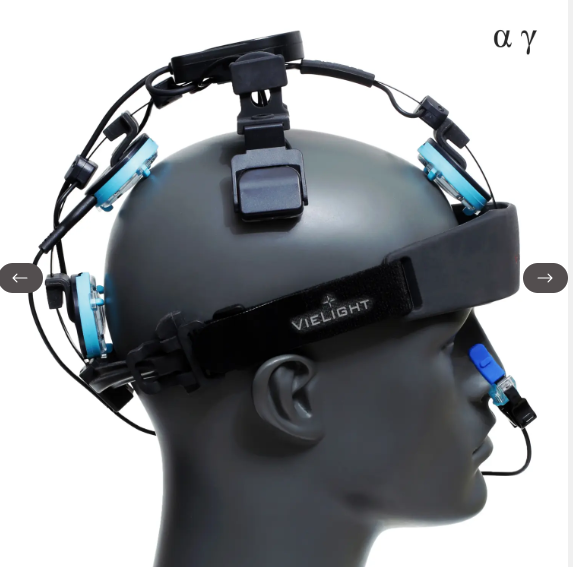
Intranasal PBM (Vielight): Vielight’s intranasal devices deliver near-infrared light through the nasal cavity, where the thin tissue allows photons to reach the ventral surface of the brain — including areas involved in blood flow regulation and olfactory function. For Long COVID patients, the intranasal approach serves a dual purpose: it increases cerebral blood flow and helps heal the damaged sinus cavities that many patients struggle with post-infection. In our clinic, we used one of the early Vielight Duo models, which combines intranasal and transcranial stimulation. At home, we continue to use the Duo alongside the Vielight MIP intranasal unit. We also recommend the MIP to the remote clients we work with who may not have unlimited funds — it’s an accessible entry point to intranasal PBM without the cost of a full transcranial system.
We often use both approaches together. The transcranial device provides broad cortical stimulation while the intranasal device targets deeper circulatory and autonomic pathways.
How Neurofeedback Addresses Long COVID Brain Patterns–What the Research Supports
Vielight’s research ecosystem is one of the most extensive in the PBM field, with published studies and active clinical trials spanning traumatic brain injury, Alzheimer’s disease, depression, PTSD, and — directly relevant here — upper respiratory viral recovery.
A landmark clinical trial of the Vielight RX-Plus (the medical device equivalent of the X-Plus 4) tested 294 participants during the COVID-19 pandemic and found that treatment patients with 0–7 days of symptoms experienced significantly faster recovery than those receiving standard care alone. For the full study population, the device showed statistically significant improvements in recovery times for symptoms including sinus pain, chest congestion, body aches, mental clarity, headaches, and cough. Certified by Health Canada, the RX-Plus remains the only photobiomodulation device backed by large-scale clinical data for upper respiratory viral recovery.
Beyond the viral recovery data, PBM’s effects on the brain are well-documented across multiple conditions that share mechanisms with Long COVID — particularly traumatic brain injury, where neuroinflammation, reduced cerebral blood flow, and mitochondrial dysfunction are central features. This mechanistic overlap is one reason we were confident applying PBM to Long COVID recovery early, before dedicated Long COVID PBM trials had been published.
What We Observed in Our Own Recovery
When Shari began PBM after her hospitalization, we chose it specifically because it was the easiest intervention to implement. She was too exhausted and cognitively compromised to engage in active brain training. She could barely climb the stairs. But she could sit in a chair with a device on her head.
The PBM didn’t require her to think, perform, or effort. The photons did the work.
I also used PBM during my recovery, alongside the breathing exercises and supplement protocol I described in the first article. While I can’t isolate the specific contribution of PBM from the other interventions we were using simultaneously, the physiological logic is clear: when the brain’s mitochondria are compromised and blood flow is reduced, delivering near-infrared energy directly to the cells addresses the root problem rather than working around it.
Neurofeedback Long COVID: Training the Brain Back to Function
Once PBM had begun restoring baseline energy to the brain — once Shari could stay awake through a full day, once her cognitive stamina had improved enough to engage in effortful tasks — we layered in neurofeedback and Neurofield stimulation (PEMF) specifically targeted at brain recovery.
Neurofeedback is a form of biofeedback that uses real-time EEG monitoring to help the brain learn to regulate its own electrical patterns. The patient watches a display that responds to their brain activity — a video that plays smoothly when the brain produces desired patterns and pauses when it doesn’t. Over time, the brain learns to produce healthier patterns on its own, through the same operant conditioning principles that underlie all learning.
What makes neurofeedback particularly powerful for Long COVID is that protocols are guided by the QEEG assessment. Rather than applying a one-size-fits-all approach, the clinician can see exactly which brain regions are dysregulated, which frequency bands are too high or too low, and design a training protocol that targets the specific patterns present in each individual patient’s brain.
Common Long COVID Patterns and How Neurofeedback Addresses Them
Based on our clinical experience with Long COVID patients — who have comprised roughly 25% of our client load in recent years — and supported by the published EEG research, here are the patterns we most commonly encounter and how neurofeedback responds to them:
Generalized EEG slowing (excess delta and theta, reduced healthy activity): This is the most common finding, consistent with the Cleveland Clinic study showing enhanced delta power and attenuated alpha-beta power in COVID patients. Neurofeedback protocols train the brain to increase faster frequencies and reduce slow-wave excess, effectively helping the brain “speed back up.”
Frontal slowing and encephalopathic patterns: The frontal lobes govern executive function — planning, decision-making, working memory, impulse control. When these regions slow down, patients describe difficulty organizing thoughts, making decisions, and maintaining focus. Targeted frontal training helps restore the faster rhythms these regions need to function.
Left temporal slowing: The left temporal region is critical for language processing. When it slows, patients experience word-finding difficulties, reduced reading comprehension, and trouble following conversations — exactly the symptoms I experienced post-COVID when I could no longer track multiple conversations simultaneously. Temporal protocols target these specific regions.
Excess alpha / slowed alpha peak frequency: The alpha peak frequency (APF) is sometimes called the brain’s “clock speed.” When it drops, everything feels slower. Training to restore normal APF helps patients feel cognitively sharper.
Spindling excess beta (SEBs): An inflammatory pattern often associated with anxiety, hypervigilance, and disrupted sleep. In Long COVID patients, it may reflect the nervous system’s chronic stress response — what Stephen Porges, in his Polyvagal Theory framework, describes as the autonomic nervous system being stuck in a state of defense. Neurofeedback can help down-regulate this excessive activation.
Beyond Neurofeedback: Neuromodulation
In addition to traditional neurofeedback, we use Neurofield stimulation — a form of pulsed electromagnetic field (PEMF) therapy — specifically targeted at the brain regions showing dysfunction on the QEEG. While neurofeedback relies on the brain training itself through feedback, PEMF delivers external electromagnetic stimulation that can help “jump-start” sluggish brain regions. In our protocol, it complements neurofeedback by providing direct stimulation to areas that may not have enough energy to respond to feedback alone.
The Therapy Arc: What Recovery Looks Like
Recovery from Long COVID brain symptoms is not a single event. It’s a process — and one that looks different for every patient depending on the severity of their infection, their pre-existing neurological health, the time elapsed since infection, and the specific patterns on their QEEG.
That said, there is a general arc that most patients follow:
Phase 1 — Energy restoration (PBM). The brain needs fuel before it can train. PBM sessions begin immediately and continue throughout the process. Early improvements often show up as better sleep, reduced fatigue, and increased cognitive stamina.
Phase 2 — Active brain training (Neurofeedback + Neurofield PEMF). Once the patient has enough cognitive energy to engage in training, QEEG-guided neurofeedback sessions begin. Most patients train 1-2 times per week. Early sessions may be shorter to avoid fatigue. Over time, session length and intensity increase as the brain builds capacity.
Phase 3 — Consolidation and generalization. As the brain’s patterns normalize, patients begin noticing improvements in daily function — clearer thinking, better memory, improved emotional regulation, restored ability to multitask and process information at their pre-COVID speed. Periodic QEEG reassessments track progress and guide protocol adjustments.
Some patients improve quickly. Others require months of consistent work. The critical variables are the severity of the initial insult, the degree of pre-existing neurological vulnerability (concussion history, Lyme disease, autoimmune conditions), and how early interventions begin after infection.
Case Study: From Five Medications to None
One case from Shari’s national presentation illustrates what’s possible when neurofeedback is applied to Long COVID with precision.
A 32-year-old woman contracted the alpha variant of COVID-19 and developed Long COVID with PTSD, depression, and anxiety. Her symptoms were severe: brain fog, breathing difficulties, fatigue, convulsions and tremors that would last for hours, headaches, and hair loss. By the time she reached our clinic, she was on five medications just to function — Sertraline, Bupropion, Aripiprazole, Diazepam, and Trazodone.
Her initial EEG told a clear story: beta on theta, a low-voltage fast beta buzz with slowing, and widespread beta excess. These patterns reflected a brain caught between hyperactivation and exhaustion — revving too fast in some frequencies while running too slow in others.
Through QEEG-guided neurofeedback training, her brain began to reorganize. Self-reported symptom tracking showed progressive improvement across sessions. Her post-training EEG confirmed the changes: less temporal slowing, reduced central beta, a significant decrease in the 22–30Hz excess range, and the development of rhythmic alpha within normal range. The brain was finding its way back.
As her brain patterns normalized, she was able to work with her prescribing physician to reduce and eventually discontinue her medications — first Bupropion, then Aripiprazole, then Diazepam, then Sertraline was halved and eventually stopped, and finally Trazodone.
In her own words: “I looked into Neurofeedback and found Shari’s team who saved my life and got me off ALL medications and helped me find my way back to living. Thank you for saving my life when I was at my worst and was going through a really dark time.”
What Shari Learned from 25% of Our Clients
Over the past several years, Shari has presented nationally on the neurological impacts of Long COVID and the role of neurofeedback in recovery. Having reviewed the EEGs of nearly a hundred Long COVID clients, she’s identified several patterns that practitioners and patients should understand:
Many patients don’t connect their symptoms to COVID. Particularly if their acute infection was mild, patients often arrive at our clinic for “brain fog” or “anxiety” without realizing these symptoms began after a COVID infection or vaccine. A careful intake history — asking specifically about COVID timing — is essential.
Symptoms often got worse over time, not better. This is consistent with the spike protein persistence data. Many patients describe a gradual decline in the months following infection rather than a steady recovery. This worsening trajectory is what makes early intervention so important.
Early non-invasive intervention has been helpful — possibly even life-saving. In Shari’s words from her national presentation: “It is important to first calm the cytokine storm and prevent hypoxia and endothelial damage. We are on the front line to help turn this process around and begin the repair.”
Partnership with holistic and functional practitioners matters. Neurofeedback and PBM address the brain directly, but Long COVID is a multi-system condition. Partnering with functional medicine doctors who can address the gut, immune, and vascular components creates better outcomes. The next article in this series covers these combination approaches in detail.
Is This Right for You?
Neurofeedback and PBM are non-invasive, non-pharmaceutical approaches to brain recovery. They don’t replace medical care — if you’re experiencing Long COVID symptoms, you should be working with your physician. But for the 80% of Long COVID patients who report cognitive symptoms, and for whom conventional medicine often has limited answers, these technologies offer a path forward grounded in measurable brain data and individualized protocols.
The first step is a quantitative EEG assessment. Not every neurofeedback provider does QEEG-guided protocols — many use symptom-based approaches that don’t account for individual brain patterns. For Long COVID specifically, the QEEG is essential because the patterns vary significantly from patient to patient, and the wrong protocol can make symptoms worse.
If you’re looking for a provider, seek one who:
- Performs a full 19-channel QEEG before beginning interventions
- Compares your brain data to normative databases
- Can explain which specific patterns they’ve identified and how their protocol addresses them
- Has experience with Long COVID, TBI, or other conditions involving neuroinflammation and EEG slowing
- Understands the importance of sequencing interventions (energy restoration before active training)
The Brain Wants to Recover
I want to end with something I’ve learned from my own experience — with six concussions, with COVID, and with years of working alongside Shari in this field.
The brain is not fragile. It is resilient. It is adaptive. When it’s injured, it compensates. When it’s given the right tools, it recovers. Not always perfectly. Not always completely. But consistently, measurably, and often more than anyone expected.
Long COVID has taught us — painfully, personally — that the brain’s resilience has limits. But it’s also shown us, over and over again in our clinic, that those limits are further out than most people think.
If you’re struggling, your brain is not broken. It’s running on low power in a damaged environment. Give it energy. Give it data-driven training. Give it time.
And if you can see the problem on a brain map, you can build a plan to solve it.
This is the second article in our Long COVID Awareness Month series. Read the first article: What Long COVID Does to Your Brain — And How We Knew Before Anyone Had a Name for It. Read next: Long COVID Recovery From the Inside Out: Detox, Supplements, and the Combination Therapies Worth Knowing About — from apheresis and hyperbaric oxygen to targeted supplements like NAC, Nattokinase, and Bromelain.
David Johansson is a neurofeedback practitioner, certified brain health coach, and the founder of TheBrainAndBody.com. He works alongside his wife Shari Johansson (MA, LPC, BCN, QEEG-D) at Total Neuro Solutions in Colorado.
Affiliate Disclosure: Some links on this site are affiliate links. I have affiliate relationships with Vielight and Neuronic. I only recommend products I have personally used and believe in based on my professional experience. Affiliate relationships never influence my assessments or recommendations.
References
- Kopańska, M., et al. (2021). Changes in EEG Recordings in COVID-19 Patients as a Basis for More Accurate QEEG Diagnostics and EEG Neurofeedback Therapy: A Systematic Review. Journal of Clinical Medicine, 10(6), 1300.
- Saab, C.Y., et al. (2022). SARS-CoV-2 Slows Brain Rhythms with more Severe Effects in Younger Individuals. Research Square (Preprint). Cleveland Clinic / Brown University.
- Porges, S.W. (2020). The COVID-19 Pandemic is a paradoxical challenge to our nervous system: a Polyvagal Perspective. Clinical Neuropsychiatry, 17(2), 135-138.
- Vielight Inc. (2024). Viral Recovery Major Clinical Trial Results — RX-Plus on upper respiratory viral recovery, 294 participants. Health Canada certified.
- Antony, A.R. & Haneef, Z. (2020). Systematic review of EEG findings in 617 patients diagnosed with COVID-19. Seizure, 83, 234-241.
- Johansson, S. (2023). Long COVID: An EEG-Based Perspective. National presentation.